
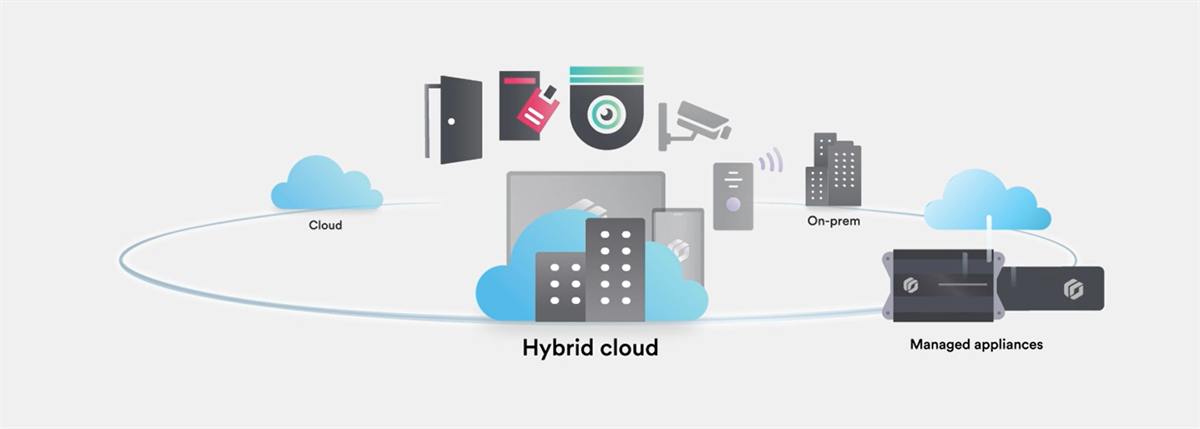
Cloud security platforms are often presented as the obvious modern answer. For some organizations, they can be. A small site with limited infrastructure, a distributed organization with many light remote locations, or a team without local IT support may have a good reason to choose a cloud-first model.
Enterprise security is different. Large campuses, healthcare systems, public-sector environments, industrial facilities, and multi-site organizations usually need more than convenient remote access. They need predictable lifecycle economics, deep feature sets, strong integrations, flexible retention, local resilience, and governance that does not depend entirely on a recurring cloud subscription.
The executive question
The decision is not cloud versus old technology. The decision is which architecture gives the organization the right balance of control, cost, performance, and operational capability over the full life of the system.
For many enterprise environments, the best answer is on-premise or hybrid. Core workloads such as recording, access control, identity integration, event routing, and high-volume video review often make sense close to the facility. Cloud can still play an important role for remote access, health monitoring, multi-site visibility, selected backups, mobile workflows, and easier support.
Where cloud fits well
- Small sites: Cloud can reduce local infrastructure needs and simplify administration.
- Many light remote locations: Branches, small offices, and low-camera-count sites may benefit from centralized administration.
- Limited local IT support: Subscription models can shift some infrastructure burden away from internal teams.
- Targeted workflows: Remote access, alerts, system health, and selected evidence sharing can be strong cloud use cases.
Why enterprise often needs on-premise or hybrid
Enterprise systems generate large amounts of persistent data. Video retention, access events, integrations, analytics, alarms, maps, credentials, and compliance requirements all create operational demands that can expose the limits of cloud-only platforms.
- Cost over time: Monthly cloud fees can look manageable at first but become expensive across hundreds of cameras, long retention periods, multiple sites, and years of ownership.
- Feature depth: Cloud platforms often trade advanced enterprise functionality for simplicity. That can be acceptable for small sites but limiting for complex operations.
- Retention and bandwidth: High-resolution video is expensive to move and store continuously in the cloud. Local recording can be more predictable and efficient.
- Operational resilience: Facilities still need security to work when internet service is degraded, congested, or unavailable.
- Integration control: Enterprise environments often need identity, access control, intercom, intrusion, building systems, reporting, and custom workflows to work together.
The hidden cost problem
The first-year cloud proposal is rarely the full financial story. Leaders should model five to seven years of subscription fees, storage, retention, camera licensing, analytics, support tiers, bandwidth, feature limitations, and migration risk. A cloud-only platform can be significantly more expensive over time while also providing a smaller feature set than a mature enterprise on-premise or hybrid platform.
This does not make cloud wrong. It means cloud should be used where it creates clear operational value, not as a default replacement for architecture planning.
A decision framework
- Use on-premise infrastructure where workloads are persistent, data-heavy, latency-sensitive, or operationally critical.
- Use hybrid services where cloud improves visibility, support, remote access, updates, or selected workflows.
- Use cloud-first platforms where the site is small, remote, simple, or not worth the overhead of local infrastructure.
- Compare architectures over the expected system lifecycle, not just the initial purchase.
The executive point
Enterprise security architecture should be designed around ownership, not hype. Cloud has a place, but most enterprise environments benefit from a hybrid strategy: keep critical, high-volume, feature-rich workloads close to the operation, then use cloud services where they add flexibility without turning the entire system into an expensive subscription dependency.